If you're keeping track, that's about 12 hours of church, and 10 in one weekend. Each session typically includes opening and closing prayers, opening and closing choir numbers, and a hymn halfway through to wake you up. Waking you up is important, as the rest of the session is mostly "talks" from general church leaders, and the talks are often the dryest sermons you could imagine, delivered from a teleprompter in a dim room. There's also a small amount of church business to conduct, which might be more interesting than usual this time, if new apostles are announced, but it's mostly talks. The talks are translated into a surprising number of languages, broadcast all over the world, and published online and on church magazines, and they largely set the direction of the LDS church for at least the next six months. Regular Sunday talks and lessons will often cite, or even be based on, these conference talks.
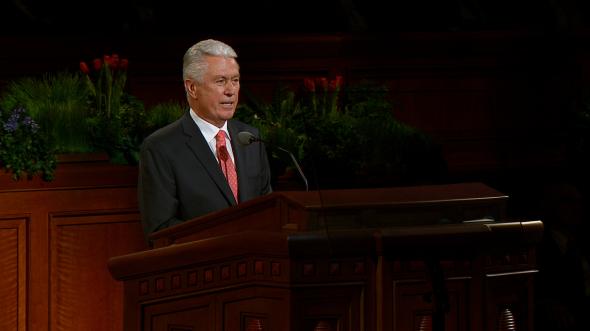 |
| This talk was a beautiful sermon on grace, and not at all dry. Every rule has exceptions. |
Conference is also wonderfully "uncorrelated." Every LDS publication is vetted by a correlation committee to ensure consistency with existing church doctrine. Conference talks, though, are not assigned or vetted ahead of time. Speakers seek inspiration to know what to say, but no mortal hand is on the tiller -- you may hear something entirely new.
What if you don't agree with what was said, though? Colloquially, "that's not doctrine" is used to mean something like "I don't believe that" or "you can't prove that from the canonical works of LDS scripture" or "that could change," or "that has changed." It's used by heterodox and orthodox alike. If you have some disagreements with current LDS teachings and you don't like what the Family Proclamation says about gender roles, just say, "well, it isn't doctrine." If you fully agree with current LDS teachings, but safely disagree with what was said about black people so many conferences ago, you can also say "that was a policy, not a doctrine."
A lot of questions are raised by this usage: what does "doctrine" consist of in the LDS Church anyways? What is the dividing line between doctrine and policy? Is something said by one of the "prophets, seers, and revelators" in the LDS Church necessarily doctrine?
Paradoxes
A lot of the dialogue about doctrine is a bit paradoxical. On the one hand, in rejecting the creeds of traditional Christianity, the LDS church has long emphasized the individual ability to learn the truth from the Holy Spirit, and to believe accordingly, and has consistently resisted attempts to systematize its theology. There are a few foundational principles that a Mormon must believe in order to fully participate in the LDS church as a temple-goer, but that list is very short, and practices matter much more than beliefs in a lot of ways -- you can be a good Mormon and still believe some unorthodox things, as long as you do what you're supposed to. We refute accusations of following our leaders like unquestioning sheep by referring to teachings about asking God, for yourself, what is true.
On the other hand, the body of generally-held beliefs not well defined, but it is fairly large, and pressure to belief it all is intense. "I know" is preferred to "I believe." Children are taught to sing "Follow the Prophet" ad infinitum, and if you don't think you should follow the Prophet, well, you need to pray harder, to get the rightanswer from God. It is commonly asserted that the Prophet will never lead the church astray, and that the revealed word of God states "whether by mine own voice or by the voice of my servants, it is the same." The old joke is that Catholics teach that the Pope is infallible, but don't believe it, and Mormons teach that the Prophet is fallible, but don't believe it.
Another paradox arises in the Book of Mormon where Jesus announces "this is my doctrine," in the context of telling disciples how to baptize, and commanding that "disputations" about that and other points of doctrine should end. (3 Nephi 11:22-40). The doctrine is that those who believe, repent, and are baptized will be visited with fire and the Holy Ghost, and will inherit the kingdom of God; those who do not are damned. This doctrine is the rock to build on, and anyone who declares more or less than this as Christ's doctrine is built on a sandy foundation. Of course, this seems very limiting -- didn't Jesus himself teach all manner of other doctrine, like "love your neighbor" and "turn the other cheek"? (Well, if you insist on literal internal consistency in scripture, Mormonism may not be a good fit for you, and traditional Christianity may not be either).
So, is doctrine a short list of foundational principles, or is it a long list of beliefs? Is it as simple as "repent, believe, and be baptized," or is it as complicated as the entire history of God's interaction with humans? One paradox that is less often noticed is that sometimes we are talking past each other, and using the word "doctrine" to mean very different things.
Church Doctrine
In general usage (LDS or not) "doctrine" just means "teachings." It comes from the Latin "docere," meaning "to teach." It might refer to church teachings, or to principles held and taught by a political party or other group, or to a principle of government policy, like the Monroe Doctrine. In the religious context, it particularly refers to teachings that are tied in some way to religious belief. So, "Joseph Smith was born in 1805" is just history, but "Joseph Smith saw the Father and the Son" involves both history and doctrine. Even though both are taught by the LDS church, only one of those teachings is really pertinent to belief. Similarly, LDS teachings about what local leaders constitute a ward council are pretty much just policy, but LDS teachings about black people and priesthood ordination involve both policy and doctrine. The pre-1978 priesthood/temple ban wasn't just a rule, but a rule with reasons that were deeply rooted in religious belief (that the "curse of Cain" attached to black people), and when the rule changed, religious belief changed along with it (the LDS church now disavows that black people are cursed, or in any way inferior to anyone else).
For clarity, it's probably best to refer to doctrine in this sense as "church doctrine." There ought to be no question as to whether the Family Proclamation is church doctrine; it clearly is. Similarly there ought to be no question as to whether the pre-1978 priesthood/temple ban was church doctrine: it clearly was. It's still useful to ask "is that church doctrine?" to distinguish official church teaching from individual opinions (which may sometimes be taught as if they were church doctrine). However, asking whether something is church doctrine isn't ultimately a question about whether it is true; it's just about whether it is an official teaching of the church.
It ought to be easy to tell what is church doctrine. Neil. L. Anderson tells us that church leaders are honest but imperfect, but that church doctrine won't be difficult to find, or hidden in an obscure paragraph of one talk; it will be taught by all 15 members of the First Presidency and Quorum of the Twelve. Or course, there will still be ambiguity at the margins, where church leaders disagree on issues that are not as central to belief (such as whether there was death before the Fall). In some such cases, it may even be difficult to tell whether church leaders are generally in agreement or whether they just don't want to contradict each other too publicly. However, core doctrines about God's plan, our fallen nature, the Atonement, and so on, ought to be fairly easy to determine.
Additionally, though, church doctrine may not always be true. It's clearest that a doctrine isn't true when it is deliberately refuted. For example, the former doctrine about the "curse of Cain" applying to black people is clearly not true, and it has been officially renounced. It's less clear, but a strong suggestion, that doctrine isn't true, when it simply fades away. For example, early church leaders justified polygamy by teaching that God himself had multiple wives in heaven, who in some way gave birth to premortal human spirits. This still has some currency as Mormon folk doctrine, and a retraction might be useful, but for the most part, it's simply not taught by top church leaders. It's not church doctrine anymore, and it may very well not be true, no matter who taught it. (I won't assert with certainty that it's false -- what do I know about God and heaven? -- but I do not believe it, and I don't imagine I'll be accused of heresy for that.) The reasonable inference from all this is that there may yet be church doctrines that are not true, that may in the future be refuted or fade away. If there is yet more to be revealed, then we might be wrong about some things now.
Revealed Doctrine
However, being wrong about anything is inconsistent with the other usage of "doctrine," which I'll call "revealed doctrine" for clarity. It's also called "the doctrine of Christ," but that risks confusion with the more limited set of principles defined in LDS scripture as Christ's doctrine. The implication in calling something "doctrine" in this sense is that it is God's own truth, as revealed to us. Asking whether something is revealed doctrine isn't a question about whether it is an official church teaching; it's a question about whether we have a good basis for believing it.
It's also much harder to tell if something is revealed doctrine. LDS scripture states that "whatsoever they [who are ordained and appointed to 'go forth' to proclaim the gospel] shall speak when moved upon by the Holy Ghost shall be scripture, shall be the will of the Lord, shall be the mind of the Lord, shall be the word of the Lord, shall be the voice of the Lord, and the power of God unto salvation." (D&C 68:4). However, this leaves the burden on us to discern when they are speaking as moved upon by the Holy Ghost.
Sometimes what is revealed doctrine is complicated. A simplistic test like "it's the word of God if it's in a general conference talk" is unsatisfactory. In one meeting, Brigham Young is reported to have preached in the afternoon against what he preached in the morning, explaining that the morning's remarks were from him, but the afternoon's remarks were from God. How much more often might that happen where the speaker speaks for himself, but does not come back in the afternoon with a correction?
Of course, modern conference speakers are not as extemporaneous and fiery-tempered as Brigham Young, I honestly believe they seek inspiration as they prepare, and speak as the Holy Ghost inspires them to do. However, that still doesn't mean that every word is scripture -- they may be generally inspired in some areas, but filling in their own words in others. For example, I personally believe that Elaine S. Dalton, former president of the general church organization for young women, was inspired to emphasize the importance of sexual morality. However, I also believe that, in following that inspired course, the emphasis on a verse suggesting that virtue is something you don't control, that someone else can take away by force, was incredibly damaging, and could not have been inspired.
Additionally, we may not be able to immediately discern what is the word of God. D. Todd Christofferson recently affirmed the words of J. Reuben Clark: "...The Church will know by the testimony of the Holy Ghost in the body of the members, whether the brethren in voicing their views are 'moved upon by the Holy Ghost'; and in due time that knowledge will be made manifest." We Mormons study scriptures and modern prophets to learn the word of God, but we should not assume that all of that is the word of God, until that knowledge is made manifest, in due time, by the Holy Ghost, to us, the members. And if there is anything I've learned from the long path to renouncing the racist doctrines of the past, it is that "in due time" may involve quite a long time.
Scripture out of Context
There are a few bits of LDS scripture that are often taken out of context and used to end debate about what is revealed doctrine or not, by clobbering doubters into submission. They are so often repeated that they deserve to be specifically addressed.
The 1890 "Manifesto" issued by Wilford Woodruff, the Prophet at the time, which led to the end of plural marriage in the LDS Church, is published in LDS scriptures accompanied by a statement of Wilford Woodruff's that "The Lord will never permit me or any other man who stands as President of this Church to lead you astray." (Official Declaration 1). Of course, it's circular reasoning to rely on an assertion of the Church President to prove that the Church President won't lead you astray -- what if the Church President was wrong about that? In context, it should be clear that Woodruff is asserting divine authority for a dramatic change. He isn't, on his own initiative, abandoning a cherished principle that so many Mormons had made sacrifices to practice, but is following the course God revealed to him. He is asserting that the Prophet will never lead the Church "astray" (i.e., in a direction opposite to the will of God), and that big changes in direction for the Church are a result of revelation, not that the Prophet can never be wrong or that all the details of church doctrine are directly from God.
Another verse, which includes "whether by mine own voice or by the voice of my servants, it is the same," is often taken badly out of context to assert that everything God's servants (but curiously only God's servants in the LDS church) say may as well have come directly from God. The full context of this quote is in a revelation recorded by Joseph Smith as the Lord's preface to the Book of Commandments -- the predecessor to the modern Doctrine and Covenants:
Search these commandments, for they are true and faithful, and the prophecies and promises which are in them shall all be fulfilled. What I the Lord have spoken, I have spoken, and I excuse not myself; and though the heavens and the earth pass away, my word shall not pass away, but shall all be fulfilled, whether by mine own voice or by the voice of my servants, it is the same. (D&C 1:37-38).These verses have specific application to the Book of Commandments, but the more general message is not that the voice of God's servants is no different from the voice of God; it is that when God's servants speak the word of God, it will be fulfilled the same as if God had spoken it. However, it still remains incumbent on us to discern when they are speaking the word of God, and when they are speaking for themselves.
In the end, church doctrine and revealed doctrine are often conflated, due to LDS insistence on one true church -- if this is God's church, how could what the church teaches be any different from what God has revealed? I believe we'd be better off, though, if we could more clearly say what we meant when we talk about "doctrine," and if we could avoid trying to clobber people into unquestioning belief.

No comments:
Post a Comment